


California Sales Tax Guide for Accounting Teams
Introduction
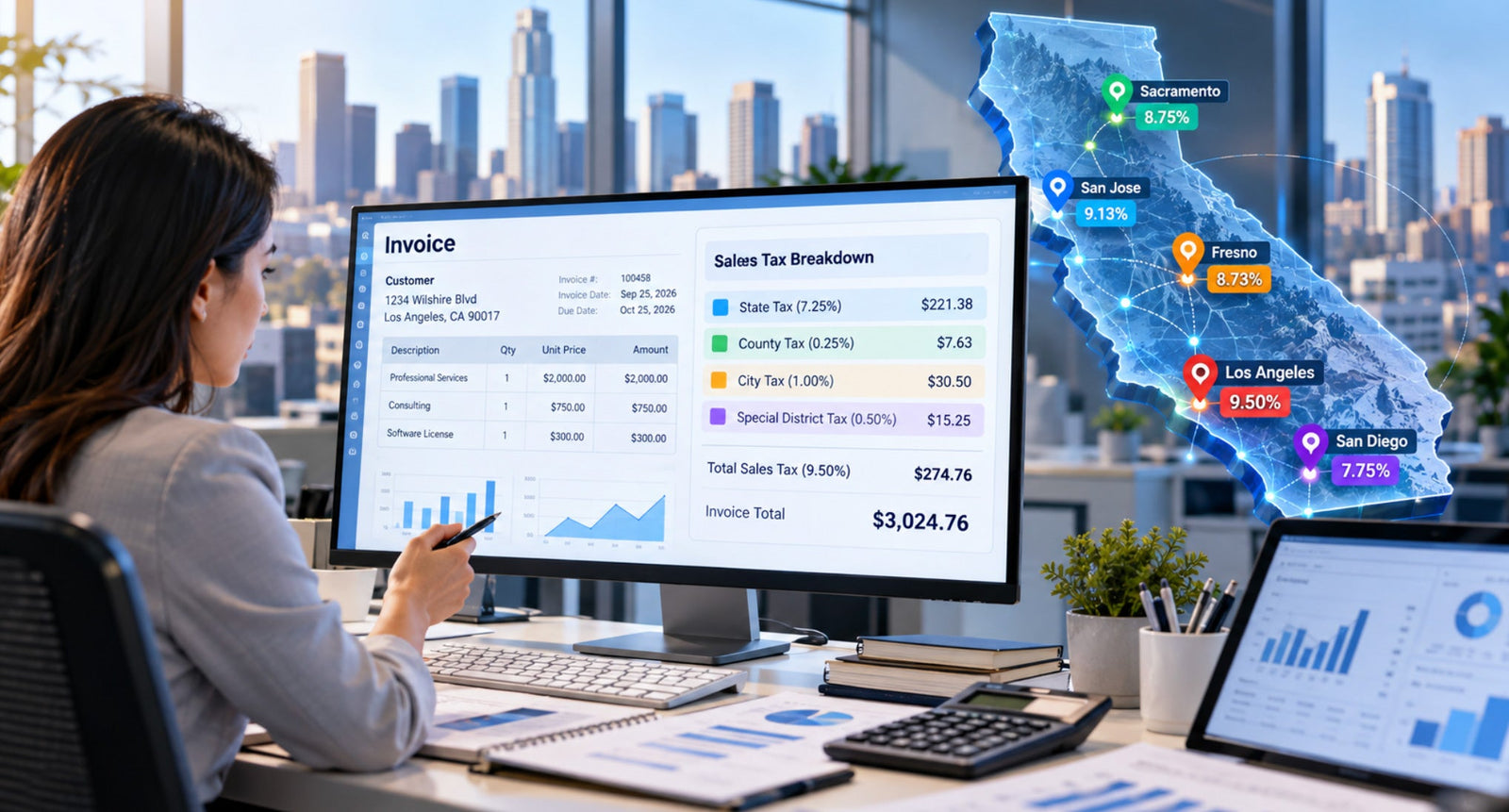
California has a statewide sales and use tax rate of 7.25%, but that is often only the starting point for your accounting team. In most areas, one or more district taxes apply, with individual district tax rates ranging from 0.10% to 2.00%. Because the total rate can vary by location, it's easy to charge the wrong rate on an invoice without noticing.
This guide explains how California's layered structure works, why address-level accuracy matters, the mistakes accounting teams make most often, and how to keep your systems aligned with current rates.
How California's Sales Tax Structure Works
California's sales tax isn't one number. The rate on a transaction generally starts with the 7.25% statewide base sales and use tax rate, with applicable district taxes added depending on the location. A jurisdiction is any government body with authority to levy a tax: the state, a county, a city, or another local taxing authority.
The California Department of Tax and Fee Administration (CDTFA) administers the state's sales and use taxes and publishes the official rates. Here's how the layers fit together.
The Statewide Base Rate
California's statewide base sales and use tax rate is 7.25%. It includes a 6.00% state portion, a 1.00% local jurisdiction portion, and a 0.25% local transportation fund portion. Rates can be higher where additional district taxes apply.
Local and District Tax Layers
The 7.25% statewide base already includes local tax components. On top of that base, cities, counties, and other local jurisdictions may impose voter-approved district taxes. This is where rates start to diverge. Two customers in the same county can face different total rates if one is inside a city with an additional district tax and the other is in an unincorporated area.
Special District Taxes
District taxes are voter-approved transactions (sales) and use taxes imposed by cities, counties, and other local jurisdictions. Individual district tax rates currently range from 0.10% to 2.00%, and some locations have more than one district tax in effect.
For your accounting team, this makes location-level accuracy important. A city name or county alone may not identify every district tax that applies, so current address-level rate data can help reduce errors in invoicing and reporting.
What About Use Tax?
Use tax applies when California sales tax wasn't collected on a taxable purchase, such as some out-of-state purchases used, stored, or otherwise consumed in California. The use tax rate is generally the same as the sales tax rate for the location where the property is used, stored, or consumed, so location-level accuracy matters when your team calculates and records it.
Why Address-Level Accuracy Matters in California
Because the layers stack differently from place to place, the correct California sales tax rate depends on the exact location where a sale is made or delivered, depending on the transaction.
A general rate for a city name or region may not identify every district tax that applies to a specific address. CDTFA provides an address-based rate lookup because district boundaries and rates can vary by location.
When the rate is wrong, the problems can spread through your workflows:
-
Invoicing: Customers are overcharged or undercharged, which can lead to disputes, credit memos, and rework.
-
Accounts receivable: Corrections and adjustments can pile up and slow down collections.
-
Reporting: The sales tax reimbursement you collect may not match the amount your business owes to the CDTFA, making returns harder to reconcile.
-
Audit exposure: Repeated rate errors can lead to additional tax, interest, and applicable penalties.
Undercharging can create a direct cost for your business. If your team collects too little, your business may still be responsible for paying the correct sales tax amount. Overcharging can require refunds or credits to customers and create additional reconciliation work.
The takeaway: in California, getting the rate right on every invoice is a basic accounting control, not an optional refinement.

Common Mistakes Accounting Teams Make with California Sales Tax Rates
Common California rate errors can come from a few predictable gaps in the workflow. Here are the ones to watch for.
Using Outdated Rate Tables
California district tax rates can change during the year as new taxes take effect, existing rates change, or taxes expire. A rate table that was right last year, or even last quarter, may already be wrong. Manually maintained tables increase the risk that your team misses a rate change before the next invoice is issued.
Missing District-Level Detail
If your system does not account for applicable district taxes, the rate used for a transaction may be too low. Some locations have more than one district tax in effect, so missing even one applicable district can result in repeated undercollection for transactions tied to that location.
Treating a General Location Rate as the Exact Address Rate
A city or county rate can be useful as a reference, but it may not identify the correct rate for every address associated with that location. CDTFA provides an address-based lookup to help identify the correct rate for a specific location.
Assuming Everyone in One City Pays the Same Rate
A city name on a mailing address doesn't always match the actual taxing jurisdiction. Addresses in unincorporated areas or locations near jurisdiction or district boundaries can carry a different combined rate than another address with the same city name.
Letting Systems Drift Apart
When your ERP, billing platform, and ecommerce store each hold their own rate data, they can disagree if they are updated from different sources or on different schedules. The same customer can be charged different rates depending on which system created the invoice if those systems are not updated from a consistent rate source.
Keeping Your Team Aligned on Accurate Rates
A practical way to reduce rate inconsistencies is to use one current source for California sales tax rates across your systems. That keeps your accounting team on one consistent set of current rates across invoicing, reporting, and review.
Use this checklist to tighten your California process:
-
Use one consistent rate source and retire local copies and manually maintained spreadsheets.
-
Confirm your rates include the 7.25% statewide base sales and use tax rate and any applicable district taxes for the specific location. Additional district taxes apply in many California locations.
-
Look up rates by specific location, not by city name alone.
-
Review rate data when CDTFA announces changes and before new rates take effect. CDTFA publishes current and upcoming rate changes by operative date.
-
Automate where you can, so rate updates reach your systems without manual re-entry.
-
Document your process so reviewers and auditors can see how rates are sourced.

This is where Zip2Tax fits. We provide accurate, up-to-date sales and use tax rates with jurisdiction-level detail, down to state, county, city, and special districts. For quick checks, your team can use Sales Tax Online Lookup. To build rates directly into your billing or ERP workflows, the Sales Tax Rate API delivers jurisdiction-level rate data directly to your systems.
For current California rate information by location, see our California sales tax rates page.
This article is for informational purposes only and is not tax or legal advice. Talk to a qualified tax professional about your specific situation.
Frequently Asked Questions
Why do California sales tax rates vary so much between addresses?
Great question. California starts with a statewide base sales and use tax rate of 7.25%, then adds any applicable district taxes imposed by cities, counties, and other local jurisdictions. Those district taxes can overlap differently by location, so nearby addresses can have different combined rates.
What is a special district tax in California?
A district tax is a voter-approved transactions (sales) and use tax imposed by a city, county, or other local jurisdiction. District boundaries don't always match city or county lines, which is why they're a frequent source of rate errors. Some locations may also have more than one district tax in effect.
Who publishes official California sales tax rates?
The California Department of Tax and Fee Administration (CDTFA) administers California's sales and use taxes and publishes the official rates.
How often do California sales tax rates change?
California district tax rates can change during the year as new taxes take effect or existing taxes are changed, extended, or expire. CDTFA publishes current and upcoming rate changes by operative date, so your team should treat California rates as data that needs regular review rather than a one-time setup.
How can my accounting team avoid California rate errors?
Great question. Use one reliable source for current, jurisdiction-level rates, check the rate for the specific address when location matters, and automate updates where you can. That helps keep invoicing, reporting, and audit prep consistent.
Keep California Rates Accurate Across Your Invoices
California's layered rate structure can create audit and reconciliation risk when your systems use outdated or incomplete rate data. Zip2Tax gives your accounting team accurate, current sales and use tax rates with jurisdiction-level detail for state, county, city, and special districts, helping your systems use a consistent set of rates.
Look up a California rate with Sales Tax Online Lookup, or automate rate lookups in your systems with the Sales Tax Rate API.
Leave a comment
Comments will be approved before showing up.